Happy 4th Anniversary, Valley of the Sun Electric Vehicle Association!
From Chance Conversations to a Statewide Movement
As Valley of the Sun Electric Vehicle Association (VOTSEVA) celebrates its fourth anniversary, we are taking a moment not just to mark the date, but to reflect on how far this movement has come. What began with a conversation, a shared belief in the power of real-world EV experiences, and a simple commitment to helping people learn by doing has grown into one of the most active and visible EV communities in Arizona.
Over the past four years, VOTSEVA has built momentum through events, partnerships, volunteers, and thousands of personal conversations that have helped turn curiosity into confidence and interest into action. As this anniversary reminds us, the story of VOTSEVA is not only about growth—it is about the power of people coming together to help shape Arizona’s electric future.
Four Years of Momentum—And the Story Before the Story
Long before there was an organization, a logo, or a single Ride & Drive event, there was a conversation.
In 2019, John Martinson and Peter Culin crossed paths through a Tesla owners’ group. On the surface, it was a simple connection—two EV owners talking about their cars. But it didn’t take long to realize something deeper was at play.
Despite coming from different generations and professional backgrounds, their paths had followed strikingly similar arcs. Both had roots in the Northeast. Both eventually made their way west to Arizona. And both had built careers grounded in entrepreneurship.
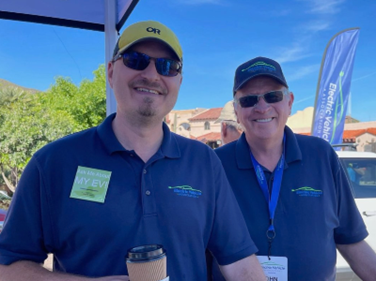
Martinson brought decades of business leadership and sustainability-focused ventures, including founding China Mist Tea Company, while Culin brought a logistics and operations background, building a freight forwarding agency that would later evolve into a BTX Global Logistics branch office.
What emerged wasn’t just shared interest. It was alignment.
Martinson brought vision, strategy, and long-range thinking.
Culin brought execution, systems, and operational discipline.
Without realizing it, they had already formed the foundation of a partnership.
That foundation found direction in early 2022.
Another Conversation Adds to the Momentum
While volunteering with the McDowell Sonoran Conservancy, Martinson met Raejean Fellows, a former President of the Electric Vehicle Association and a Director at Plug In America. Like many great turning points, it started with something simple—they both arrived in electric vehicles and started talking.
That conversation didn’t end there.
A few months later, Fellows reached out with a direct ask: would he be willing to start a Scottsdale chapter?
Martinson didn’t overthink it. He made a call.
“We can do this together.”
On the other end of the line was Culin.
With that, the idea moved from possibility to action.
The Momentum Takes Shape
What began as the Scottsdale Electric Vehicle Association was never intended to be just another chapter. From the beginning, it took on a different tone—less about presentations and persuasion, and more about experience.
People weren’t told why electric vehicles mattered.
They were invited to sit in them. Drive them. Ask questions. Have real conversations with real owners.
It was simple. It was approachable. And it worked.
By Earth Day 2022, the effort had taken shape. The chapter officially launched, soon evolving into the Valley of the Sun Electric Vehicle Association. What started as a local initiative quickly became something more—an emerging model for how EV education could actually connect with people.
Not through theory, but through experience.
Not through pressure, but through curiosity.
And as the months went on, that model proved itself again and again.
Then came September 30, 2023.
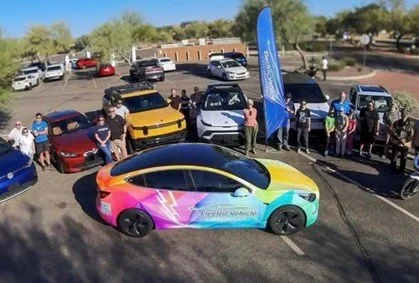
A Ride & Drive event in partnership with the City of Phoenix and the Valley of the Sun Clean Cities Coalition brought everything together at scale. Dozens of vehicles. Hundreds of test drives. A steady flow of people stepping into EVs for the first time—not as spectators, but as participants.
Something shifted that day.
This wasn’t just a successful event. It was validation.
The model worked—and it could go further.
A few months later, that realization was echoed in an unexpected way. An email arrived from the Valley of the Sun Clean Cities Coalition, outlining an opportunity: a three-year grant through DRIVE Electric USA, supported by the U.S. Department of Energy.
The message behind it was unmistakable.
What you’ve built works. Now take it across Arizona.
Momentum Turned Into Movement
On January 5, 2024, DRIVE Electric Arizona was officially incorporated. What began as a local chapter effort had become something much bigger—a statewide platform for EV education and advocacy, capable of reaching rural communities, Tribal Nations, and entirely new audiences. It created the structure to build lasting partnerships with utilities, cities, and organizations, and laid the foundation to scale what had already been proven on the ground.
This wasn’t a pivot. It was an expansion.
The Valley chapter didn’t stop. It evolved—becoming part of a broader, more powerful model that combined community-driven depth with statewide reach. Local events, volunteers, and real-world conversations remained at the heart of the work, now supported by growing strategy, partnerships, and infrastructure.
And through all of it, the core idea never changed.
Give people the experience—and let that experience speak for itself.
This is the moment where a grassroots effort became a movement—not by changing direction, but by doubling down on what worked.
From a single Ride & Drive to a statewide initiative.
From a conversation to a catalyst.
From one community to all of Arizona.
Looking back, it’s easy to trace the milestones: the events, the partnerships, the formation of a statewide organization. But those milestones only tell part of the story.
What really drives this movement is something far less formal.
It’s the conversations between strangers at an event.
The moment someone drives an EV for the first time.
The shift that happens when curiosity replaces uncertainty.
Thousands of those moments have happened since that first conversation in 2019.
And they all point to the same conclusion:
The most powerful force behind EV adoption isn’t technology.
It’s people.