Why Used EVs Make So Much Sense
Used electric vehicles are having a moment, and for many buyers, that is very good news. The market is seeing a wave of off-lease EVs, which means more selection, better pricing, and many more options with over 200 miles of range than shoppers could find just a few years ago. In our guide pictured here, Your Guide to Buying a Used Electric Vehicle, it is noted that many used EVs with 200+ miles of range are now available in roughly the $15,000 to $25,000 range, with some strong entry models priced even lower.
The Benefits of Buying Used
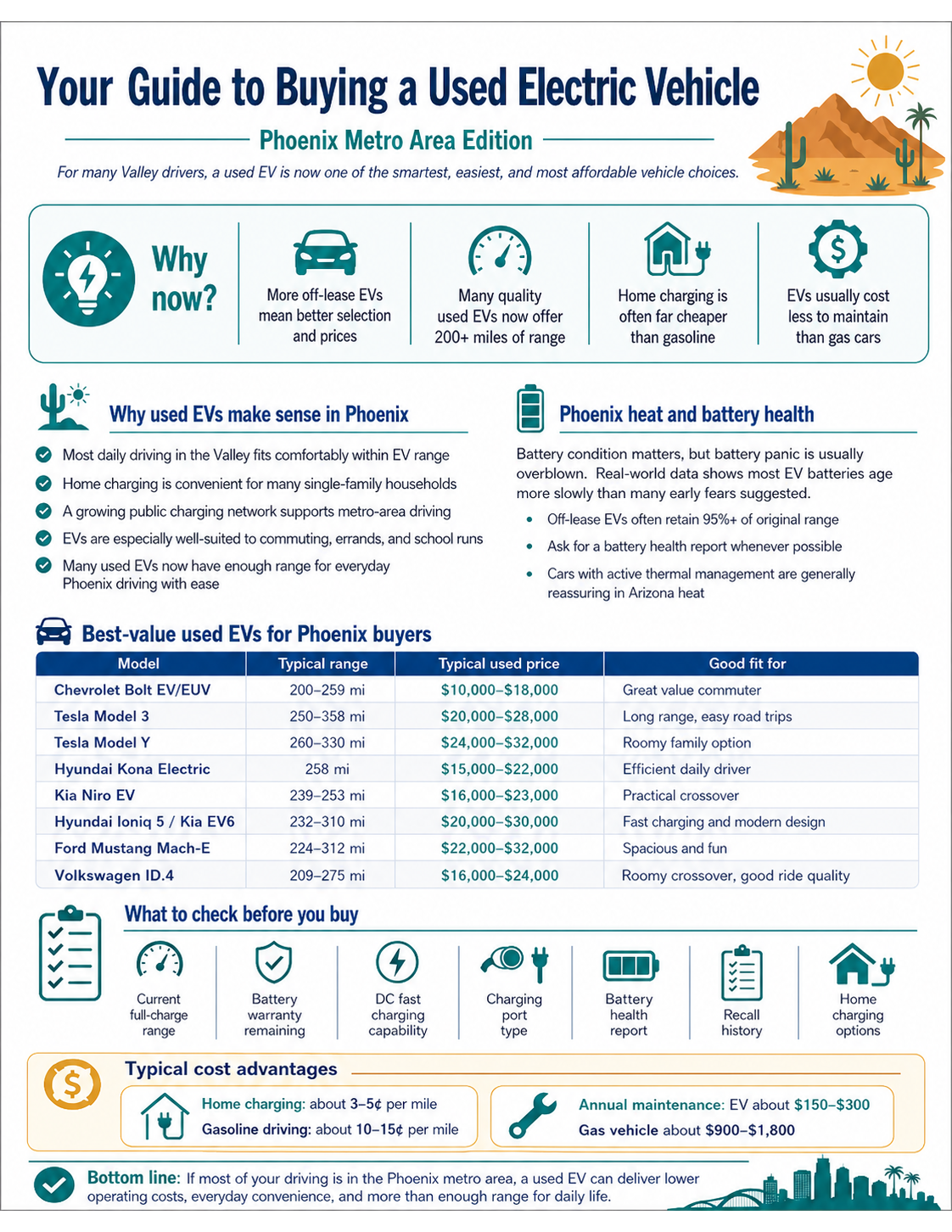
One of the biggest benefits of a used EV is lower operating cost. Compared with a gas vehicle, an EV typically costs less to fuel at home and much less to maintain. Our guide estimates home charging at about 3–5 cents per mile, compared with roughly 10–15 cents per mile for gasoline, and says maintenance costs can average around $150–$300 per year for an EV versus about $900–$1,800 per year for a gas vehicle. That difference adds up quickly.
Used EVs also tend to be simpler vehicles mechanically. No oil changes, no spark plugs, no exhaust-system repairs, and no transmission service make ownership easier and often less stressful. Regenerative braking can also significantly reduce brake wear, another savings many first-time EV buyers do not realize until after they own one.
A second major advantage is that battery durability has turned out to be much better than many people feared. The guide notes that a 3%–5% range drop in the first few years is common, followed by a long, much slower decline, and that off-lease EVs typically still retain 95% or more of their original range. It also cites Cox Automotive testing of nearly 80,000 used EVs, finding an average battery health score of 92%.
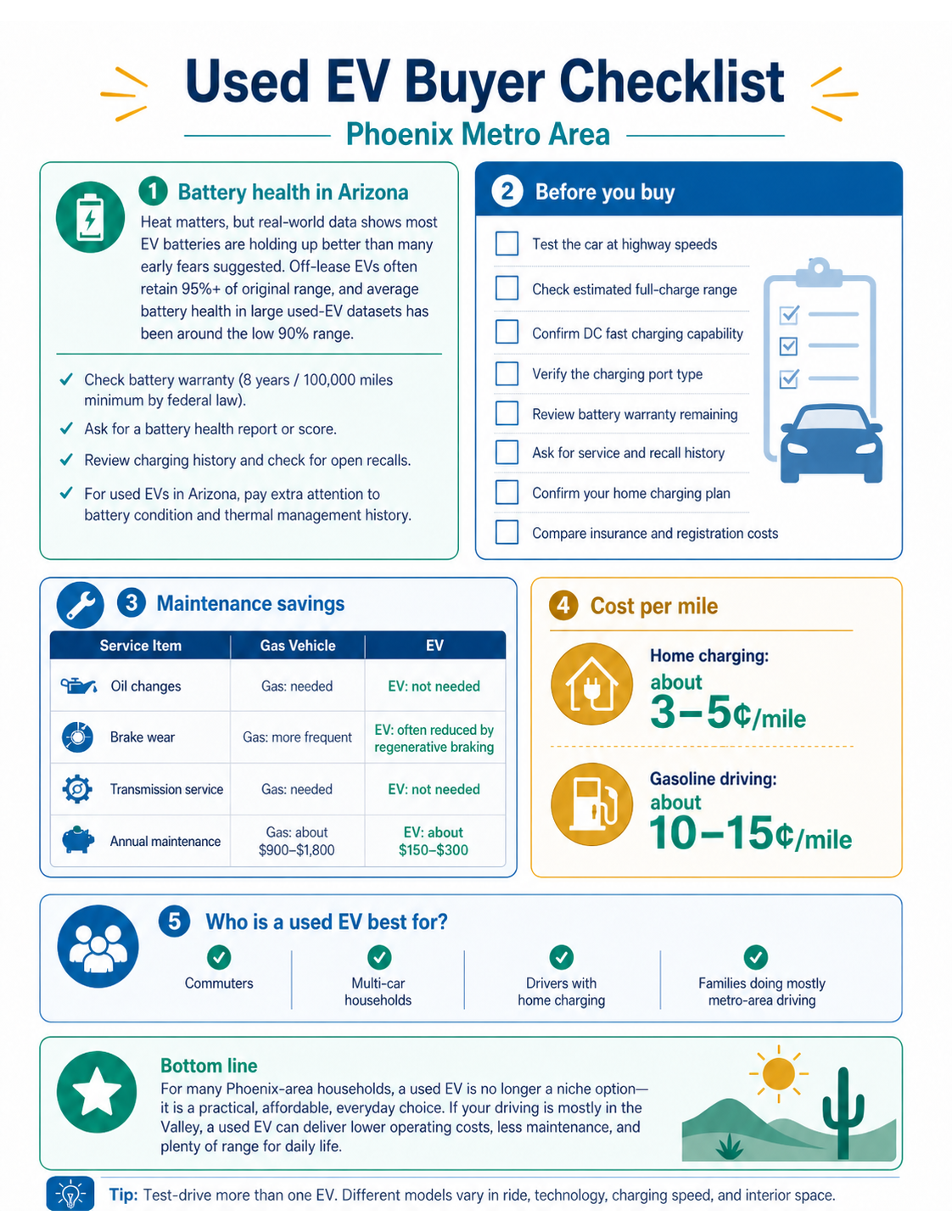
So what should shoppers look for when buying a used EV? First, check the remaining battery warranty. Federal law requires at least an 8-year/100,000-mile battery warranty, and many automakers go beyond that. Second, ask for a battery health score or battery report if one is available. Third, confirm the vehicle’s real-world range, charging speed, and whether it includes DC fast charging if you expect to road-trip or rely on public charging.
It is also smart to pay attention to model-specific issues. For example, the guide notes that older Nissan LEAF models had less-effective battery cooling, so buyers should check battery bars and battery health carefully. By contrast, vehicles like the Chevrolet Bolt EV/EUV, Tesla Model 3, Tesla Model Y, Hyundai Kona Electric, Kia Niro EV, Hyundai Ioniq 5, Kia EV6, and Volkswagen ID.4 are highlighted as strong used-EV values depending on budget and needs.
The bottom line is simple: a used EV can be one of the smartest buys in today’s car market. Buyers can often get modern range, lower fueling costs, lower maintenance, and a quieter, smoother driving experience for less than many people expect. The key is to shop carefully, ask good questions, and focus on battery health, warranty coverage, and charging capability—not just sticker price.