
Regenerative Braking.
Every time an electric vehicle slows down, it has an opportunity to recover energy. Regenerative braking turns the vehicle’s momentum back into electricity and sends it to the battery instead of wasting it as heat.
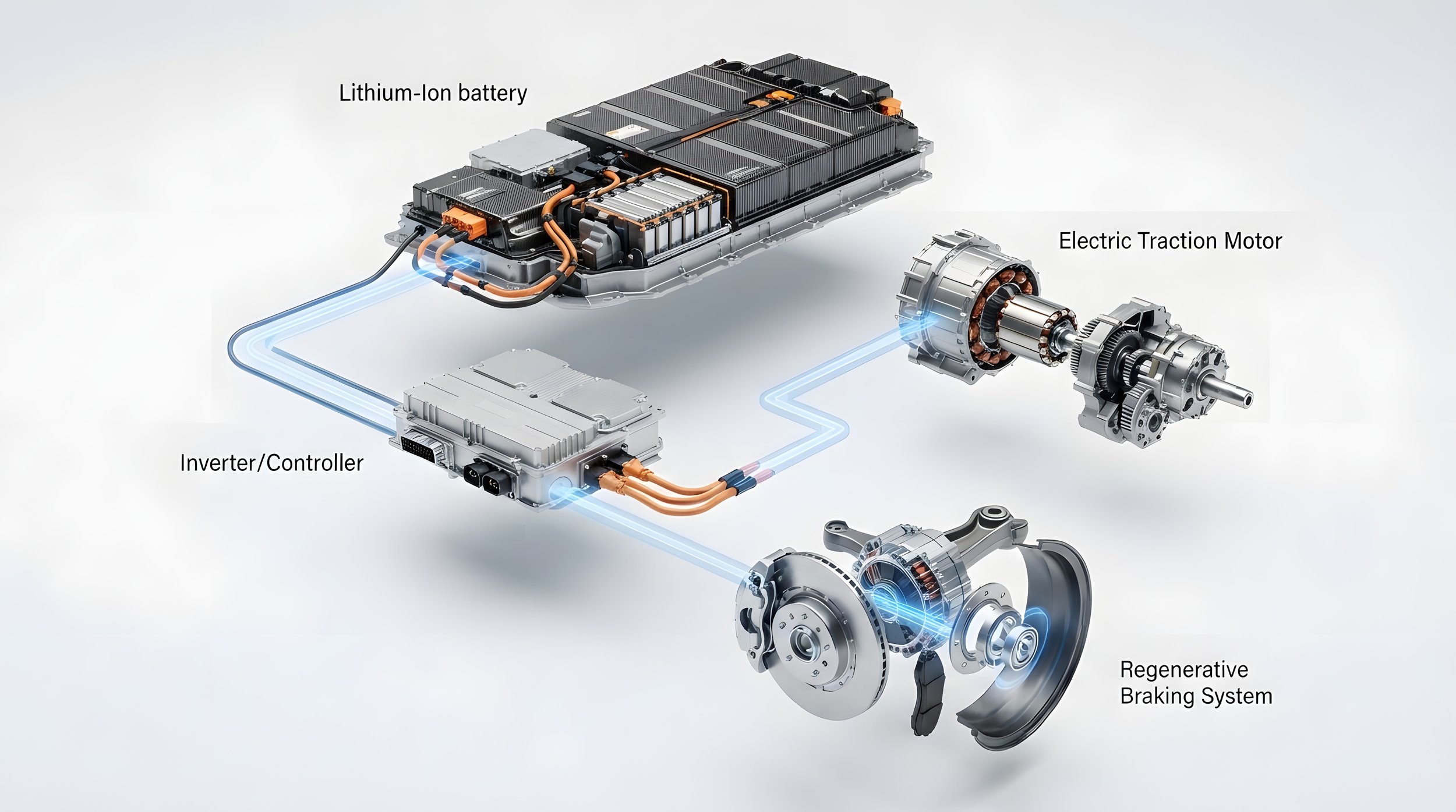
Your EV recycles its momentum.
In a conventional gas-powered vehicle, braking relies primarily on friction. Brake pads press against rotors, converting the vehicle’s motion into heat that escapes into the air.
Electric vehicles can do something more useful. When you lift your foot from the accelerator or press the brake pedal, the electric motor can operate in reverse. Instead of consuming electricity to move the vehicle, it generates electricity as the vehicle slows.
The recovered electricity is returned to the battery, helping the vehicle make better use of energy that would otherwise be lost.
Three steps. One smarter system.
The transition from forward motion to recovered electricity happens automatically as you drive.
You lift your foot
Releasing the accelerator tells the vehicle that you want to reduce speed.
The motor reverses roles
The drive motor becomes a generator and uses the vehicle’s momentum to produce electricity.
Energy returns to the battery
The recovered electricity is stored and can be used again to help move the vehicle.
Better every time you slow down.
Regenerative braking improves more than energy efficiency. It also changes the everyday driving experience.
More energy from every charge
Recovering energy during deceleration helps the vehicle use its stored electricity more efficiently.
Less reliance on friction brakes
The electric motor handles much of the routine slowing, reducing how often the mechanical brakes must engage.
Quick and predictable response
Regenerative braking begins as soon as you ease off the accelerator, creating smooth and immediate deceleration.
A smoother driving rhythm
Drivers can manage speed more naturally in traffic, on winding roads, and during frequent stop-and-go driving.
Press to go. Lift to slow.
Strong regenerative braking makes one-pedal driving possible. In many EVs, you can accelerate and manage most routine slowing with a single pedal. The brake pedal remains available whenever additional stopping power is needed.
One Pedal. More Control.
A responsive, intuitive way to manage acceleration, deceleration, and energy recovery.
Efficiency that works every mile.
Regenerative braking and one-pedal driving help make electric vehicles smoother, more responsive, and more efficient. Energy that once disappeared as heat can now be recovered and used again.